Are you at risk and adequately insured?
Is your reinstatement cost assessment up to date?
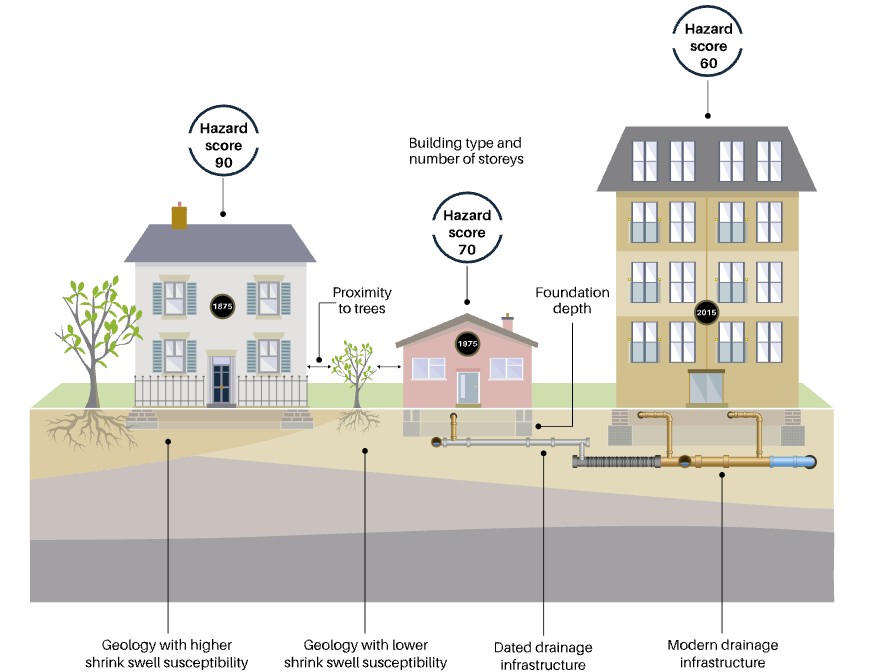
Courtesy of The British Geographical Society
2026 is shaping up to be a particularly significant year for building cracking and subsidence in parts of south-east England, principally because of the exceptionally dry and hot conditions and the prevalence of shrinkable clay soils.
What is happening in 2026?
The most important development is the combination of:
- prolonged below-average rainfall
- unusually high temperatures
- substantial soil-moisture deficit
- active vegetation/tree water abstraction; and
- extensive areas of shrinkable clay, particularly London Clay and related formations such as the Wadhurst Clay found in parts of Kent and East Sussex
An interesting article on this issue can be found at the link below:
UK Heatwave 2026: Will Extreme Heat Cause Subsidence and Foundation Cracks?
The Institution of Structural Engineers reported in June that the prolonged dry weather and heatwave conditions were raising particular concerns for buildings founded on shrinkable clay. It identified the summer of 2026 as presenting an elevated subsidence risk.
An article that anticipated the rise of drought issues is at the following link:
https://www.istructe.org/resources/blog/could-summer-become-a-subsidence-year/
The British Geological Survey has also specifically identified London, Kent and other parts of south-east England as particularly susceptible to shrink–swell-related subsidence.
The current evidence points particularly towards:
London and the London Clay belt
- Greater London
- South and south-east London
- North London
- parts of west London
Kent
- particularly areas underlain by shrinkable clay
- the London Basin/Kent clay belt
East Sussex
- particularly areas underlain by shrinkable clay
Essex
- particularly the areas around the Thames and London Basin
Surrey
- substantial areas of clay geology, particularly around the London Basin
Thames Valley/Oxfordshire
- pockets of susceptible clay soils
The BGS describes shrink–swell-susceptible geological formations as being concentrated particularly in south-east Britain.
Why cracking can become apparent this year
A typical mechanism is:
hot/dry weather → increased evapotranspiration → loss of soil moisture → clay shrinkage → ground movement → differential foundation movement → cracking
Trees can substantially amplify this effect. Tree roots extract water from the ground and that this can cause shrinkage and uneven settlement beneath shallow foundations.
The RHS similarly identifies prolonged drought on shrinkable clay, particularly where trees are present, as a mechanism for foundation subsidence and structural cracking. Cracking commonly appears around windows and doors.
There is evidence that 2026 is already producing increased activity
This is not merely a theoretical climate-change projection.
A Verlingue insurers report in July 2026 that, based on claims activity and notifications it was seeing, signs of subsidence activity were emerging earlier than is typical for the time of year, with the possibility of further increases during summer and autumn if dry conditions continued.
There is also wider evidence of severe soil-moisture deficit this year. Drying and shrinkage of clay soils has been sufficiently significant to affect railway infrastructure in southern and eastern England.
An important point for owners
Cracking appearing in 2026 does not automatically mean that the building has developed subsidence.
There are several competing mechanisms that can produce cracking:
| Mechanism | Typical relevance in SE England in 2026 |
| Clay shrinkage/subsidence | High |
| Tree-related foundation movement | High where trees are present |
| Drain leakage/washout | Significant |
| Poor/insufficient foundations | Significant, particularly older buildings |
| Thermal movement | Moderate |
| Settlement of extensions | Common |
| Differential movement between old/new construction | Common |
| Roof spread / structural movement | Possible |
| Cavity wall/brickwork defects | Common |
| Render/plaster shrinkage | Very common |
| Localised ground instability | Site-dependent |
Consequently, the 2026 weather conditions increase the prior probability of subsidence, but they do not establish causation in an individual property.
The timing is also important
For a building survey carried out now, we would regard recently developed or progressively widening stepped cracking as particularly worthy of investigation where the property is:
- founded on shrinkable clay
- relatively old and likely to have shallow foundations
- close to mature trees
- adjacent to leaking or defective drainage
- showing cracks concentrated around openings; and/or
- exhibiting corresponding distortion internally and externally.
BGS specifically notes that older buildings with shallow foundations can be particularly susceptible.
The BGS’s current Property Subsidence Assessment is particularly useful because it goes beyond geology. Its property-level assessment considers geology, foundation characteristics, building type, storeys, drainage and tree proximity.
How we assess cracking
For a surveyor, we would separate the investigation into:
1. Is there genuine structural movement?
Look for:
- stepped masonry cracking;
- diagonal cracking from corners of openings;
- displacement of masonry;
- separation between extensions and original buildings;
- distortion of openings;
- cracking continuing through both internal and external finishes;
- changes in floor levels;
- sticking doors/windows associated with distortion.
2. Is the movement progressive?
This is critical. A historic crack can look dramatic but be inactive, whereas a relatively small crack that is demonstrably widening may be more significant.
3. What is the mechanism?
Particularly:
- clay shrinkage and tree influence + shallow foundation, versus:
- leaking drain and localised washout, versus:
- construction/settlement/thermal movement.
4. Is it actually subsidence?
The word subsidence is often used too readily in property reports. Differential foundation movement can have many causes, and cracking alone does not establish that the ground beneath the building has subsided.
Under insurance
Did you know that as of early 2026, an estimated 70% of UK properties are underinsured, with claimants receiving an average of only 67% of their expected payout? Reinstatement cost assessments do require cyclical revaluation. Check out the informative link below for further information:
Consequences of Underinsuring Your Property UK: The 2026 Risk Guide
This year, the average claim for subsidence has increased to £20,000, according to the Association of British Insurers.
If you require an assessment of cracking and/or a building reinstatement cost assessment (a building insurance valuation) you can call us on 01892 710765.
If you quote Insure1, we will apply a 10% discount to all our fees charged up to 1 November 2026.
Signature Surveyors Ltd (September 2026)